
The Architecture of Global Internet Traffic
The modern internet is not a flat expanse of equal nodes; it is a highly stratified ecosystem where a handful of platforms dominate user attention. Understanding the hierarchy of the most-visited websites provides critical insights into digital behavior, infrastructure demands, and the economic engines of the web. For developers and platform architects, these top-tier sites represent the benchmark for scale, reliability, and user engagement. This analysis explores the defining characteristics of the world's most popular websites, focusing on the technical and strategic implications of their massive reach.
Defining the Leaders: Search, Social, and Video
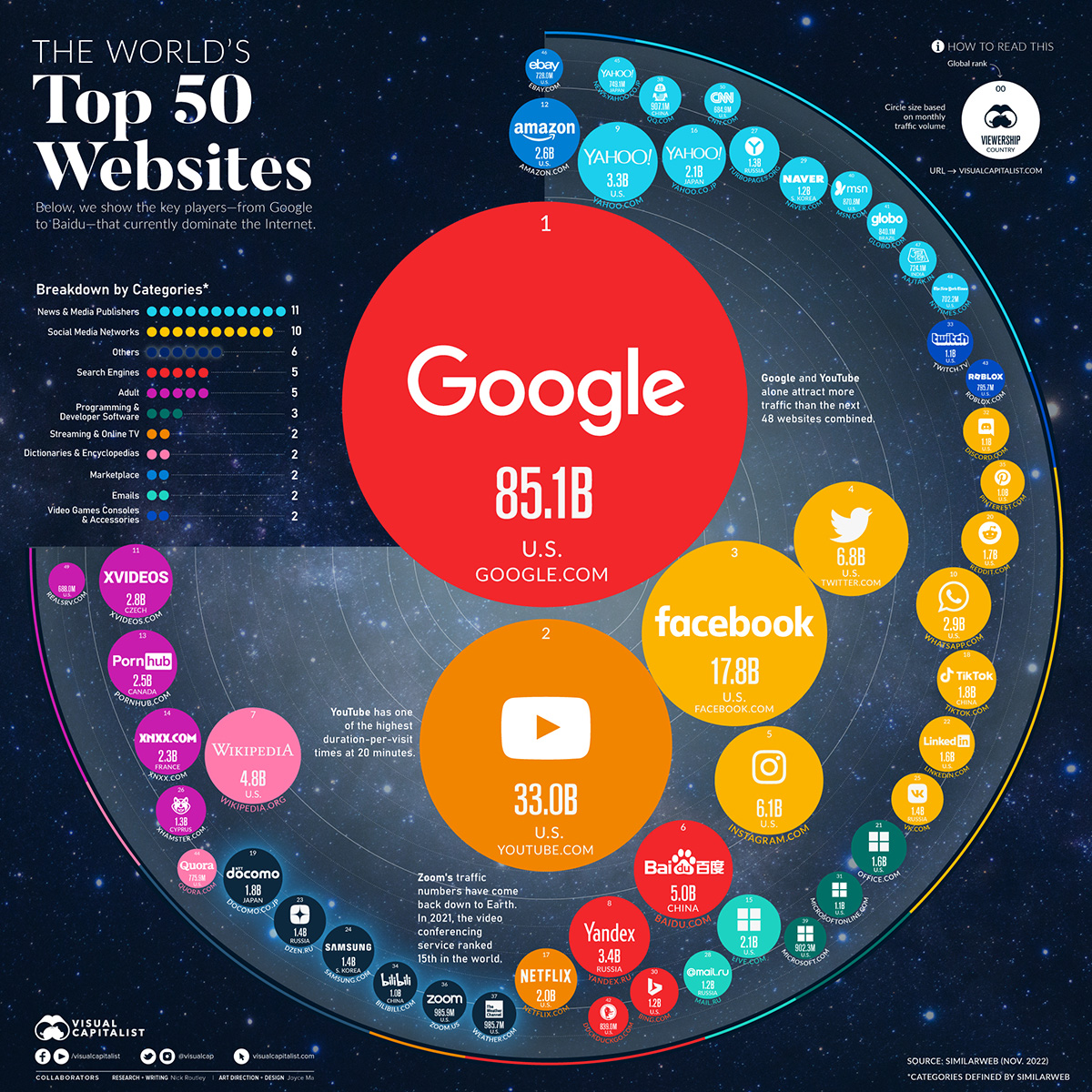
Historically, the top of the traffic charts has been occupied by a consistent trio of categories: search engines, social media networks, and video streaming services. Google has long held the position of the most-visited website globally, serving as the primary gateway for information discovery. Its dominance is not merely a result of brand recognition but of its unparalleled algorithmic precision and the sheer volume of daily queries it processes. Following closely are social giants like Facebook and YouTube, which have evolved from simple communication tools into comprehensive digital ecosystems that host news, commerce, and entertainment.
The distinction between these platforms is crucial for web developers. Search engines are transactional in nature; users arrive with a specific intent and leave once their query is satisfied. In contrast, social and video platforms are designed for retention. They utilize complex engagement loops, infinite scrolling, and personalized recommendation engines to maximize time-on-site. This difference in user intent dictates the underlying technical architecture. Search platforms prioritize speed and index freshness, while social platforms prioritize real-time data synchronization and media delivery optimization.
The most-visited websites are not just destinations; they are the foundational infrastructure of the modern digital economy, shaping how billions of users interact with information and each other.
Technical Implications for Platform Developers
For developers building competing platforms or integrating with these giants, the scale of these top-visited sites presents both a challenge and a roadmap. The infrastructure required to support hundreds of millions of concurrent users involves sophisticated load balancing, global content delivery networks (CDNs), and robust database sharding strategies. The most-visited websites demonstrate that scalability is not a one-time achievement but a continuous engineering effort.
Furthermore, the data generated by these platforms is a primary asset. The ability to collect, process, and analyze user behavior at this magnitude allows for hyper-personalization. Developers must consider how to implement similar data pipelines without compromising user privacy or performance. The shift towards edge computing and serverless architectures is largely driven by the need to replicate the responsiveness of these top-tier sites. If a platform cannot match the sub-second load times and seamless user experience of the leaders, it risks losing users to the established giants.
Regional Variations and Emerging Markets
While the global list is dominated by Western tech giants, the landscape varies significantly by region. In markets such as China, Russia, and India, local platforms often hold the top positions due to language barriers, cultural preferences, and regulatory environments. For instance, Baidu, WeChat, and VKontakte frequently appear at the top of their respective national charts. This regional fragmentation means that global developers cannot rely on a one-size-fits-all strategy. Understanding local traffic patterns is essential for market entry and user acquisition.
Moreover, the rise of mobile-first internet access in emerging markets has shifted the technical priorities for these top-visited sites. Lightweight web applications, optimized for low-bandwidth connections, are now standard. Developers must ensure that their platforms are accessible on a wide range of devices, from high-end smartphones to basic feature phones. This focus on accessibility and performance under constrained conditions is a key differentiator in competitive markets.
The Future of Web Traffic: AI and Integration
As artificial intelligence becomes more integrated into web experiences, the definition of a "website" is evolving. The most-visited platforms are increasingly becoming AI-driven assistants that can perform tasks, answer complex questions, and generate content. This shift may alter the traffic dynamics, as users may spend less time navigating between pages and more time interacting with a single, intelligent interface. Developers should watch for the integration of generative AI into core web functionalities, as this could redefine user engagement metrics and platform value.
Additionally, the convergence of e-commerce, social media, and content creation is blurring the lines between different website categories. Platforms that successfully integrate these elements are likely to maintain or increase their traffic share. The future of the most-visited websites will be characterized by deep integration, AI-enhanced personalization, and a relentless focus on user retention.

Conclusion
The list of most-visited websites is a dynamic indicator of global digital trends. For developers and platform architects, these sites serve as the gold standard for performance, scalability, and user experience. By analyzing the technical and strategic approaches of these leaders, developers can gain valuable insights into building resilient and engaging digital products. As the web continues to evolve, staying attuned to the shifts in traffic patterns and user behavior will be essential for success in the competitive landscape of developer platforms.