
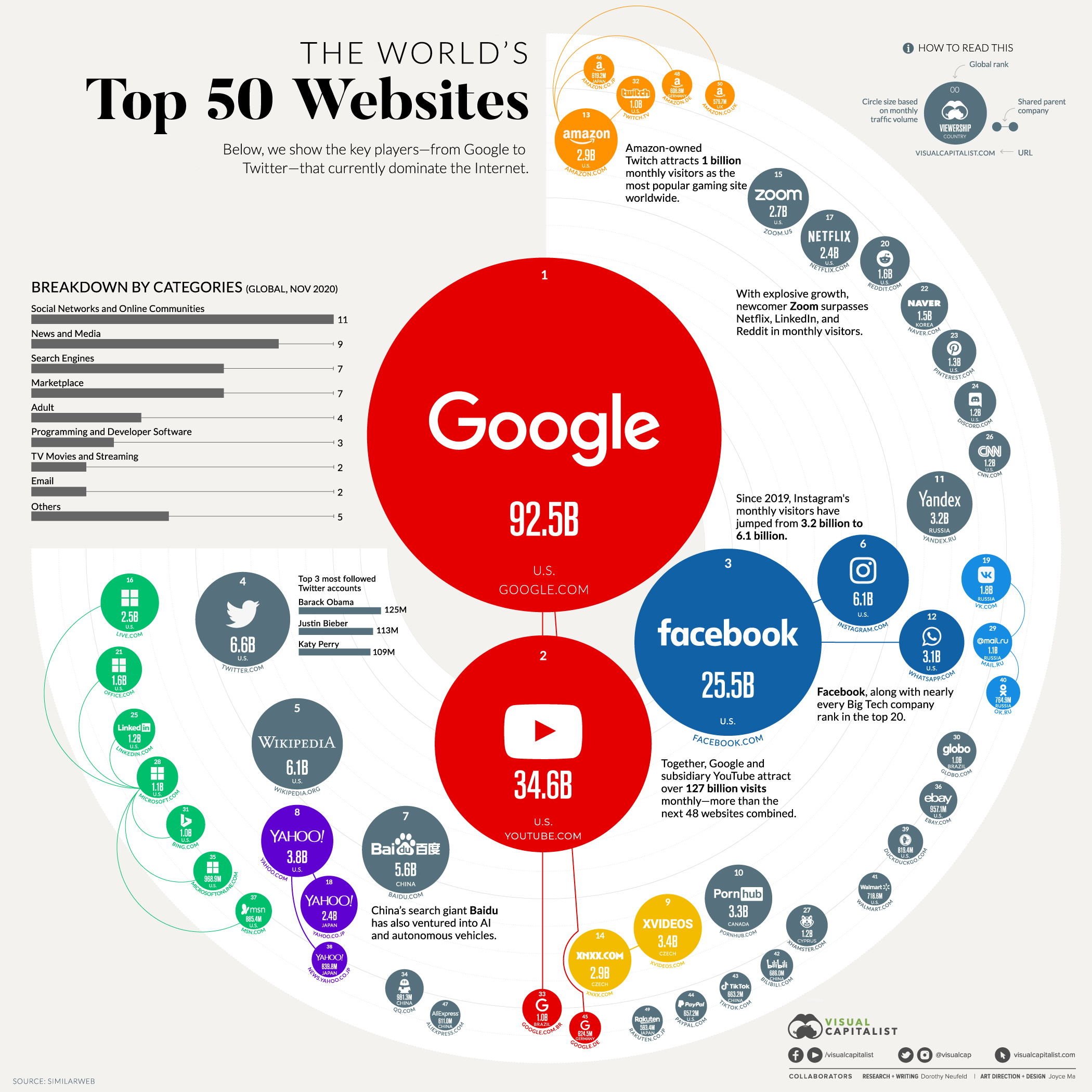
The digital landscape is dominated by a select group of platforms that capture the majority of global internet traffic. Understanding the hierarchy of the most-visited websites is essential for developers, marketers, and business leaders who rely on these infrastructures to reach their audiences. While the specific rankings can fluctuate based on the data provider and the timeframe, certain names consistently occupy the top tier of the global web. This article explores the structural dominance of these platforms, the technical implications for developers, and the shifting dynamics of user engagement in the modern era.
The Titans of Traffic
At the apex of the most-visited websites list, search engines and social media giants form an unbreakable core. Google has long held the position of the most visited site in the world, serving as the primary gateway for billions of users seeking information. Its dominance is not merely a result of brand recognition but of its utility as a universal utility. Following closely are social networking platforms such as Facebook, YouTube, and WhatsApp. These sites do not just host content; they host communities. The shift from static web pages to dynamic, interactive feeds has fundamentally changed how traffic is measured and valued. For developers, this means that the 'destination' of a user is no longer a single page but a continuous stream of interactions within a walled garden.
Developer Platforms and Infrastructure
For technical readers, the list of most-visited websites is also a map of critical infrastructure. These top-tier sites are built on robust, scalable architectures that handle petabytes of data daily. They serve as the benchmark for performance, security, and availability. When a developer builds an application, they often integrate with the APIs of these major platforms. For instance, social login features, video embedding, and search indexing are all dependent on the stability and policy changes of these dominant entities. The reliance on these platforms creates a complex web of dependencies. A change in the API of a top-visited site can have ripple effects across thousands of third-party applications. This interdependence highlights the importance of understanding the technical stack behind these giants, from their use of content delivery networks (CDNs) to their proprietary algorithms for content ranking.
The Impact of Mobile-First Design
The rise of mobile internet has reshaped the landscape of the most-visited websites. In many regions, mobile traffic now exceeds desktop traffic, making mobile optimization a non-negotiable requirement for any website aiming for high visibility. The top sites have adapted by adopting responsive design and progressive web app (PWA) technologies, ensuring that their services are accessible even on low-bandwidth connections. This shift has also influenced the way developers approach web performance. Core Web Vitals, a set of metrics used by Google to evaluate page quality, has become a critical factor in search rankings. Developers must now prioritize loading speed, interactivity, and visual stability to compete in an environment where user attention spans are shrinking and connectivity can be unreliable.
The most-visited websites are not just destinations; they are the operating systems of the modern internet, dictating the standards for speed, security, and user experience.
Emerging Trends and Future Watchpoints
While the traditional giants maintain their lead, new trends are beginning to challenge the status quo. The rise of short-form video content has propelled platforms like TikTok and Instagram Reels to the forefront of user engagement. These platforms are redefining what it means to be 'visited,' as users spend longer periods of time within the app rather than navigating between pages. Additionally, the growth of e-commerce and streaming services continues to drive significant traffic, with sites like Amazon and Netflix consistently ranking in the top ten globally. For developers, this presents both opportunities and challenges. The demand for real-time data processing, personalized recommendations, and seamless cross-device experiences is at an all-time high. Staying ahead of these trends requires a deep understanding of both the technical and behavioral aspects of web traffic.

Practical Implications for Web Developers
For those working in web development, the data from the most-visited websites offers valuable insights. By analyzing the technologies and strategies used by these top performers, developers can identify best practices for their own projects. This includes adopting modern frameworks, optimizing for search engine visibility, and ensuring robust security measures. Furthermore, understanding the traffic patterns of these sites can help developers anticipate peak load times and plan their infrastructure accordingly. The ability to handle high concurrency and maintain low latency is a key differentiator in today's competitive digital market. As the web continues to evolve, the most-visited websites will likely remain the central hubs of digital activity, but the nature of that activity will continue to shift. Developers who stay informed about these changes will be better positioned to build applications that are not only functional but also resilient and future-proof.
In conclusion, the list of most-visited websites is more than a ranking; it is a reflection of the global digital economy. It highlights the platforms that shape how we communicate, consume information, and conduct business. For technical readers, understanding this hierarchy is crucial for making informed decisions about technology stacks, integration strategies, and performance optimization. As we look to the future, the focus will remain on creating seamless, secure, and efficient web experiences that can withstand the pressures of ever-increasing global traffic.