

Cloudflare Introduces Clef and Clef-flash
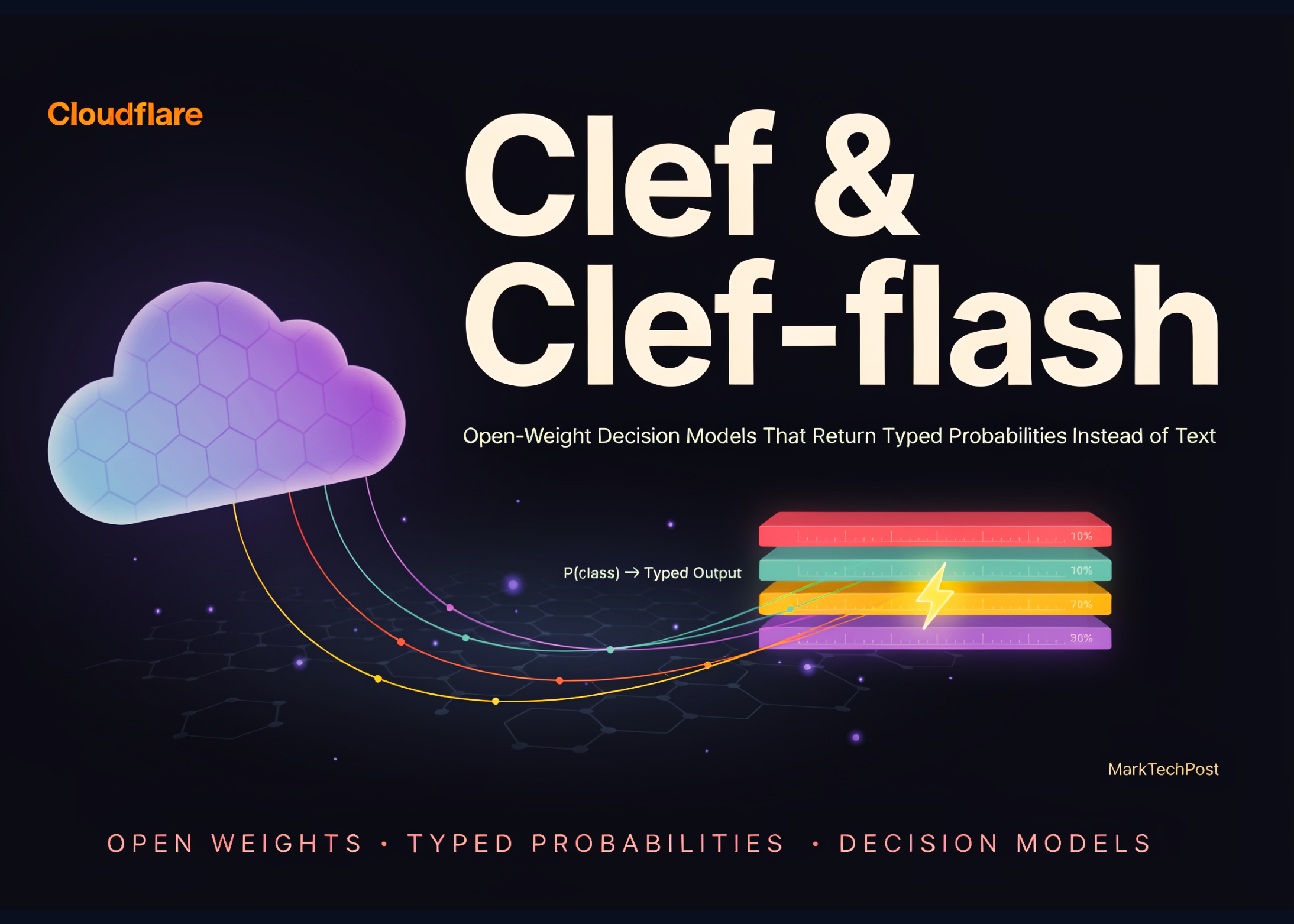
Cloudflare has officially released Clef and Clef-flash, marking a significant shift in how developers interact with artificial intelligence on the web. Developed by the Workers AI team, these are not traditional chatbots. Instead, they are specialized decision models designed to process input states and return structured, typed probabilities rather than free-form text. This release represents a pivotal moment for web developers seeking deterministic, high-speed AI integration directly within their application infrastructure.
Defining the Decision Model Architecture
The fundamental difference between Clef and standard Large Language Models (LLMs) lies in the output format. While an LLM generates tokens sequentially, requiring complex parsing to extract data, a decision model answers a fixed set of questions about a specific input. Clef supports three distinct question types, allowing developers to define a schema of typed questions. The model then returns a probability score for every allowed answer. This approach eliminates the ambiguity often associated with natural language generation, making it ideal for critical business logic where precision is paramount.
Both models run today on Workers AI, and the weights are on Hugging Face for self-hosting.
Technical Foundations and Compatibility
Both Clef and Clef-flash are released under the Apache 2.0 license, ensuring they are open-weight and accessible for commercial and personal use. They are fully compatible with TypeSafe AI’s Jev API, which launched as the first ‘System One’ model in September 2026. For developers already using the Jev ecosystem, switching to Clef is straightforward; it requires only changing the endpoint and model name. This compatibility ensures that existing infrastructure can leverage the new models without significant architectural overhauls.
Under the hood, Clef is post-trained from Qwen3.8-27B, while Clef-flash is derived from Qwen3.5-9B. Both models retain the backbone’s vision encoder, enabling them to process visual data alongside text. The inference process is optimized for speed and efficiency, occurring in two distinct stages. First, the backbone performs a single prefill-only pass over the input state and questions. Second, a small transformer, known as the joint schema head, reads the final hidden states. This head routes evidence to each question, allows fields to cross-attend, and scores all options jointly before applying a per-question softmax to generate probabilities.
Performance and Benchmarking
Cloudflare’s internal testing on the Decision Index 0.2.1 suite reveals competitive performance. In a 10-benchmark shortlist, a Clef model scored highest on seven metrics. However, the proprietary Jev model maintains leads in specific areas, such as GPQA Diamond and MMLU-Pro. On TypeSafe’s workflow evaluations, Clef outperformed Jev in three out of four areas, including invoice processing and customer service, though margins were narrow. In a practical threat intelligence workflow, Clef classified a domain in just 2.2 seconds, significantly faster than the 4.7 seconds recorded for gpt-oss-120b. While these figures are vendor-reported, they suggest a strong potential for real-time web applications.
Deployment and Developer Tools
For developers, the integration path is clear. Both models are callable through the Workers AI binding, the REST API, or the AI Gateway. Teams looking to self-host can utilize the model cards, which detail testing on a single H200 GPU with BF16 weights. Furthermore, Cloudflare has announced a new reinforcement learning service designed to tune Clef on private data. This pipeline combines AI Gateway, Workers AI, Containers, and a new Trainer component. Currently, access to this tuning service is limited to Cloudflare’s forward-deployed engineers, with a self-serve platform planned for later release. Developers interested in early access can apply via the design partner form.
Implications for Web Development
The release of Clef and Clef-flash signals a maturation of AI in web development. By moving away from generative text toward structured decision-making, Cloudflare is addressing a core pain point for engineers: reliability. The ability to deploy these models directly on the edge via Workers AI reduces latency and enhances data privacy. As the ecosystem around System One APIs grows, with open alternatives like Kev-9B and Laya already emerging, the competition to provide the most efficient decision model will likely intensify. For technical readers, the key takeaway is that the era of parsing LLM outputs for simple classification tasks is giving way to native, probabilistic decision models that are faster, safer, and easier to integrate into modern web architectures.