
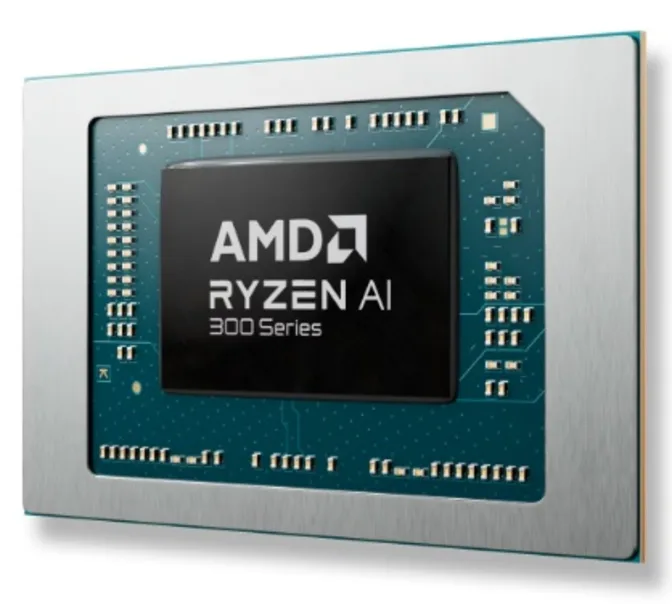
Overview of the AMD Ryzen AI 9 HX 370
The AMD Ryzen AI 9 HX 370 represents a significant milestone in mobile processor technology, debuting in June 2024 as part of the Strix Point family. This Advanced Processing Unit (APU) is designed to deliver high-performance computing for laptops and mini-PCs, integrating powerful CPU, GPU, and dedicated AI acceleration capabilities. As the flagship of the initial Strix Point lineup, the HX 370 targets users who require robust multitasking, creative workload handling, and emerging AI-driven features in a portable form factor.
Architecture and Core Design
At the heart of the HX 370 is a hybrid core architecture comprising 12 CPU cores and 24 threads. This configuration includes four full-performance Zen 5 cores and eight efficiency-focused Zen 5c cores. The Zen 5 cores operate at clock speeds ranging from 2.0 GHz to a maximum of 5.1 GHz, while the Zen 5c cores run at lower frequencies to optimize energy efficiency. AMD states that the Zen 5 microarchitecture delivers a 16% improvement in Instructions Per Clock (IPC) over the previous Zen 4 generation, primarily through enhanced branch prediction and other architectural refinements.
The processor is built on TSMC’s 4 nm manufacturing process, which contributes to improved energy efficiency compared to older nodes. The chip supports high-bandwidth memory options, including LPDDR5x-8000 and DDR5-5600, ensuring that data throughput does not become a bottleneck for the high-performance cores. Additionally, the HX 370 features native USB 4 support, which also enables Thunderbolt compatibility, and PCIe 4.0 connectivity for high-speed storage and peripheral expansion.
Integrated Graphics and AI Acceleration
One of the standout features of the Ryzen AI 9 HX 370 is its integrated graphics, the AMD Radeon 890M. Based on the RDNA 3+ architecture, this iGPU includes 16 Compute Units (CUs) with 1024 unified shaders, running at up to 2,900 MHz. This makes it one of the most powerful integrated graphics solutions currently available in the mobile sector. While it is not a replacement for discrete high-end GPUs, it is capable of handling 1080p gaming at lower detail settings for recent titles and supports driving up to four 4K monitors at 60Hz.
For artificial intelligence workloads, the processor integrates the XDNA 2 Neural Processing Unit (NPU). This dedicated hardware delivers up to 50 INT8 TOPS (Trillion Operations Per Second), significantly accelerating AI inference tasks such as real-time video enhancement, background blur, and local language model processing. The total chip-level AI performance reaches 80 TOPS when combining the NPU with the CPU and GPU. Notably, the graphics engine supports encoding and decoding for popular codecs like AVC, HEVC, VP9, and AV1, though it does not currently support the newer VVC codec.
The integrated XDNA 2 NPU delivers up to 50 INT8 TOPS for accelerating various AI workloads.
Performance Benchmarks and Comparisons
In terms of raw performance, the HX 370 competes closely with top-tier mobile processors from both AMD and Intel. In the Cinebench 2026 single-thread benchmark, the processor achieved an average score of 481 points, with a median of 479. This places it on par with or slightly ahead of competitors such as the Intel Core Ultra 7 255H and the AMD Ryzen AI 9 HX PRO 470. In multi-core performance ratings, the HX 370 scores 42.2 points, which is comparable to the Intel Core Ultra 9 285H and the AMD Ryzen AI 9 HX 375.
Real-world testing in devices like the Minisforum AI X1 Pro and the Geekom A9 Max shows consistent performance, with single-thread scores ranging from 473 to 491 points depending on the specific system configuration and thermal limits. The processor’s thermal design power (TDP) is set at a base of 28 W, but laptop and mini-PC manufacturers can increase this to 54 W or higher to maximize performance, a practice commonly seen in high-performance mobile devices.

Practical Impact and Future Outlook
The introduction of the Ryzen AI 9 HX 370 signals a shift toward more powerful AI-capable mobile processors. For professionals and enthusiasts, this means faster local AI processing, improved multitasking efficiency, and better graphics performance without the need for a discrete GPU. The support for high-speed memory and modern connectivity standards ensures that these devices remain future-proof for several years.
As AI workloads become more common in everyday applications, the 50 TOPS NPU will play a crucial role in enabling new features that were previously impossible on mobile hardware. Readers should watch for upcoming software optimizations that leverage the XDNA 2 NPU more effectively, as well as potential updates to codec support. The HX 370 sets a high bar for mobile performance, and its competitors will likely respond with similar advancements in AI and efficiency in the coming months.